Outcome First finds the companies with a genuine reason to consider change, then gives your sales team the intelligence, opportunity and approach needed to start a serious conversation.
The future of lead generation is opportunity discovery.
Find the opportunity→Reach the right buyer→Make the conversation easier to win
Why ordinary outbound fails
Most prospecting finds people to contact.Outcome First finds reasons to engage.
Ordinary outbound
Outcome First
Finds matching companies
Finds commercially relevant change
Personalises a pitch
Develops a genuine opportunity
Asks for attention
Gives the buyer something worth considering
Measures activity
Works toward qualified sales conversations
We don’t send prospects pitches.We send them opportunities.
Outcome Radar
Your next customer may not be ready today.We keep watching for the moment that changes.
Outcome Radar is developed to retain promising accounts, track meaningful business changes and reconsider them when new evidence creates a stronger reason to engage.
The longer the system learns about your market, the more informed your opportunity portfolio becomes.
Outcome Radar watches for meaningful change in the accounts it holds. Over time the pool of your monitored prospects will be in the thousands.
What Outcome First produces for your sales team
Two documents.One earns the conversation.The other helps you win it.
For the buyer
The Opportunity Drop
A researched commercial insight about one company, delivered before the first sales conversation. It is useful on its own, so the buyer gains something even if they never take the meeting. The meeting then offers something more: testing the analysis against their real numbers.
Opportunity Drop
Confidential commercial briefing · Illustrative example
The Expansion Efficiency Opportunity
Prepared for the Group Finance leadership at Example Co.
3new markets. One finance operation to support them.
Executive Opportunity BriefExample Co. · Group Finance
01 / The insight
An overlooked commercial implication of your expansion
Your recent international growth may be increasing complexity across financial reporting and reconciliation. There could be an opportunity to scale operations without corresponding growth in administrative costs.
3new markets announced
$144Kindicative annual capacity value*
1working session to test it
Why now
A planned review of finance systems falls in the same window as three market launches. That is when an operating model is easiest to change, and when added complexity is easiest to prevent.
02 / Key evidence
Entry into three additional international markets announcedCompany press release · 14 Oct 2026Verified
Finance operations roles advertised in two of the new locationsCareers page · Nov 2026Verified
Review of finance systems planned for the coming financial yearInvestor presentation · 3 Sep 2026Verified
07 / The next conversation
A focused 45-minute working session to test the assumptions against your operating data and decide whether the opportunity is commercially meaningful.
*Hypothetical inputs. Not verified information about Example Co. Adjust the model on page 4.
Supporting analysisExample Co. · Group Finance
02
What we found
The evidence behind the observation
Evidence
Source and date
Status
Entry into three additional international markets
Company press release 14 Oct 2026
Verified
Finance operations roles advertised in two new locations
Careers page Nov 2026
Verified
Finance systems review planned for the coming year
Investor presentation 3 Sep 2026
Verified
Reporting and reconciliation effort rises with each added jurisdiction
Commercial reasoning
Inference
Opportunity Graph. Three public developments, read together, point to a commercial implication that no single announcement shows.
Alternative explanation considered
The finance hiring may reflect local compliance requirements rather than rising reconciliation workload. Validation question 2 on page 6 tests this.
Supporting analysisExample Co. · Group Finance
03
Potential impact
Illustrative financial model
What could process inefficiency be costing?
Adjust these hypothetical inputs to see how the opportunity changes. None represent verified information about a real company.
Annual processing labour cost$360,000
Potential annual capacity value$144,000
40% of effort freed as capacity60% remains
USD. Assumes all transactions require the stated manual effort and the time reduction applies to all of them. This represents theoretical labour capacity value, not guaranteed cash savings, and excludes implementation cost. Actual financial benefit requires validation.
Supporting analysisExample Co. · Group Finance
04
The cost of doing nothing
What could happen if the current approach continues?
Today (hypothetical)8,000 hrs
After growth10,400 hrs
If processing volumes grow by 30% while manual effort per transaction stays constant, the organisation may require proportionately more processing capacity. That could increase labour requirements, constrain scalability or divert resources from higher-value work.
2,400extra processing hours a year, if effort per transaction stays constant
$108,000conditional annual labour cost of that capacity
The key question is not whether growth creates complexity. It is whether the existing operating model can absorb that growth efficiently.
This is a conditional analysis, not a finding that Example Co. currently suffers these costs. The current approach may already be efficient, in which case there is no opportunity.
05
An opportunity worth exploring
A practical path to value
A focused review of multi-entity reporting and reconciliation workflows could show whether processing effort can grow more slowly than transaction volume.
What would need to be true
Manual effort is concentrated in a few repeatable steps.
The new markets add meaningful transaction volume.
The planned systems review leaves room for process change.
A named owner in finance can act on the findings.
Supporting analysisExample Co. · Group Finance
06
What still needs validation
The questions that determine whether this is real
Unknown
Why it matters
1. Existing systems To validate
Sets how much of the effort can change without replacing platforms.
2. Operational constraints To validate
Local rules, approval chains and timing may limit what can change.
3. Actual economics To validate
Replaces the hypothetical inputs with real volumes, time and cost.
4. Implementation feasibility To validate
Whether a change fits the planned systems review and team capacity.
5. Ownership To validate
Who in finance would own the outcome and any decision.
07
The next conversation
A specific, valuable reason to meet
We propose a focused working discussion to test the assumptions and determine whether the opportunity is commercially meaningful.
Walk through the evidence10 min
Replace the hypothetical inputs with your operating data20 min
Decide whether the opportunity is material15 min
AM
Alex MorganAccount Director, Sample Supplier Ltd (fictional)
Example Drop for a fictional company. Names, figures and sources are illustrative.
For your sales team
The Sales Battle Card
Walk into every conversation knowing why it matters. When an opportunity reaches your sales team, they receive the commercial context needed to prepare, lead the conversation and make the opportunity easier to progress.
Sales Battle Card · Example
Meridian Cold Chain
Regional cold-chain distributor. An invented account, shown for illustration.
Opportunity accepted
Everything arrives in one place
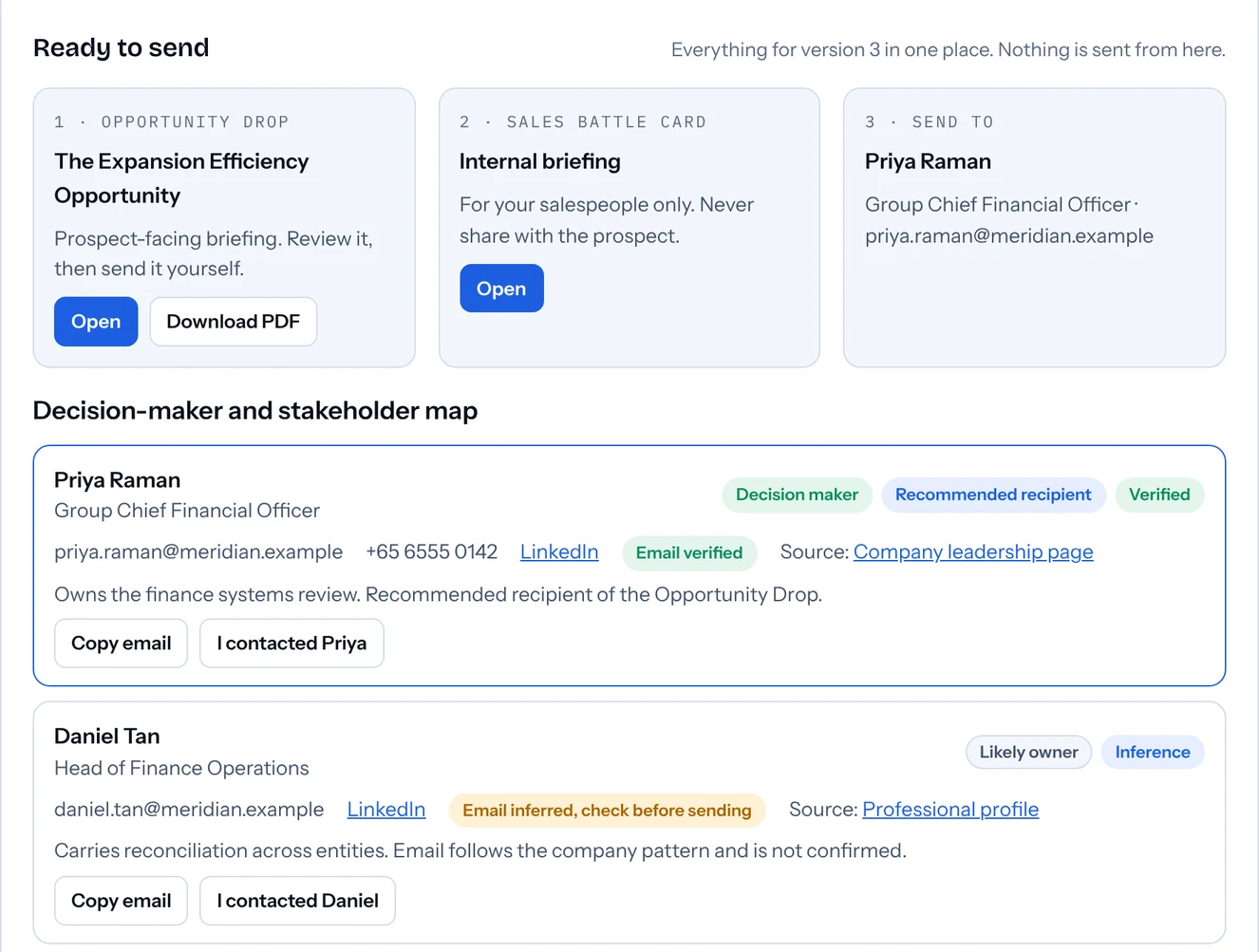
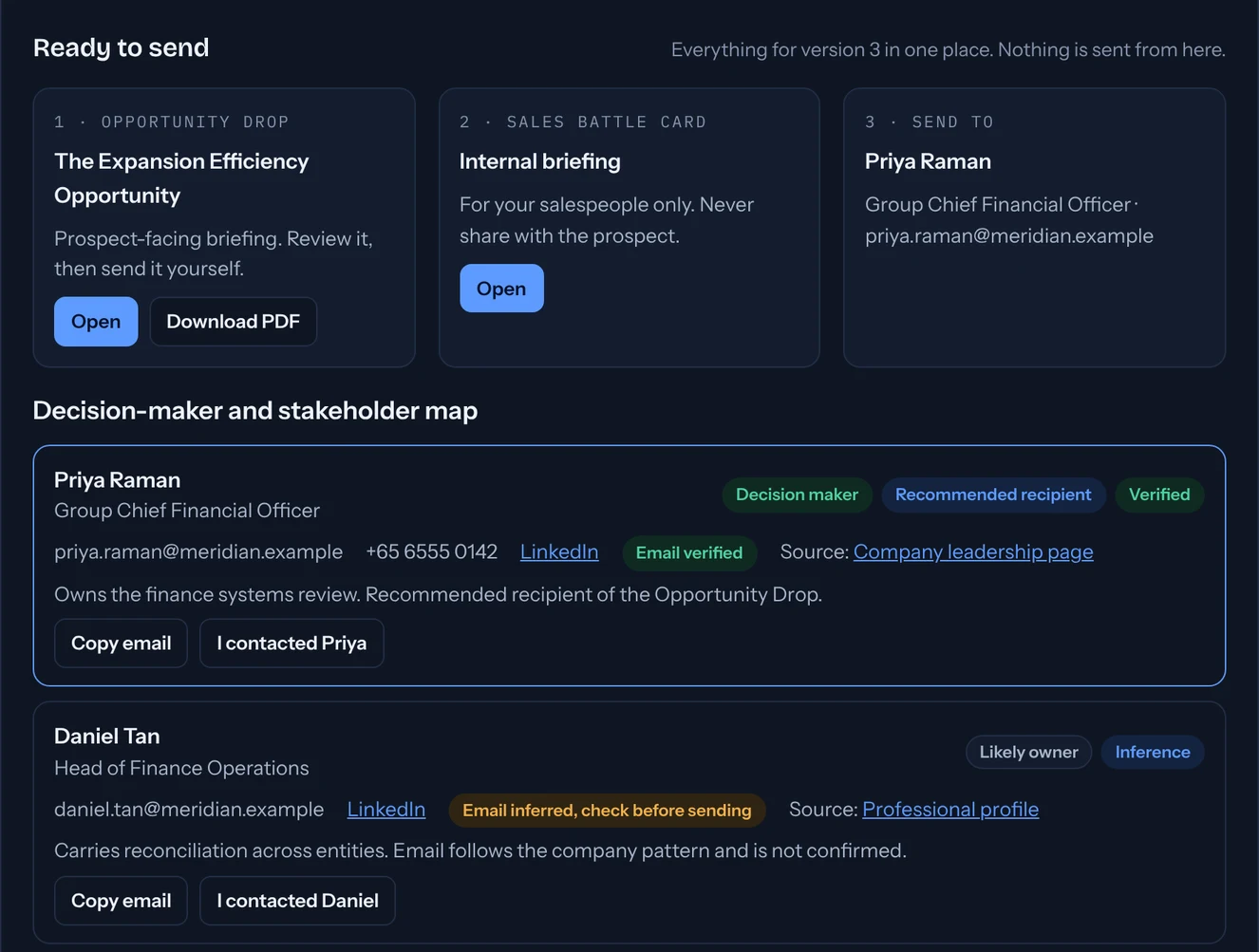
Open an opportunity and the Drop, the Battle Card and the people to send it to are already there. You review, then you send it yourself.
Sample data, illustrative
The new sales capability
Opportunity intelligence and activationfor high-value B2B sales.
Outcome First discovers opportunities worth pursuing now, keeps promising future accounts in view and equips salespeople with the intelligence needed to convert attention into serious conversations.
What we learn feeds the next discovery
The technology
Advanced Super Intelligence research and commercial reasoning allow Outcome First to investigate more companies, connect more evidence and revisit more potential opportunities than a conventional prospecting team could practically manage.
Fewer accounts pursued without a reason
Better timing
Deeper account intelligence
Stronger opening conversations
Better-prepared salespeople
Promising future opportunities retained
An opportunity portfolio that becomes more informed over time
0
accounts monitored for you. The longer Outcome First works, the bigger the pool grows, and every account in it is watched for a reason to engage.
Learn the offer, define the market and begin discovery.
Month 2
Investigate accounts, create opportunities and begin activation.
Month 3
Refine the approach, equip sales and evaluate the evidence.
Who the pilot suits
High-value B2B sales
A clear offer and ideal customer
A sales team ready to follow up
Someone who knows your market
Open to reviewing the evidence together
Is Outcome First an AI SDR?
No. An AI SDR automates outreach volume. Outcome First works earlier and goes deeper. It finds companies with a reason to consider change, builds the opportunity and equips your salespeople to lead the conversation.
What happens to companies that are not ready?
They stay in view. Outcome Radar keeps promising accounts, watches for meaningful change and brings an account back when new evidence gives a stronger reason to engage.
What does my sales team receive?
Your sales team receives both documents for every accepted opportunity. The Opportunity Drop is ready to send to the prospect, and it is built to earn the meeting. The Sales Battle Card is the intelligence to run that meeting and close the deal: the reason to engage, the evidence, the stakeholders, likely objections, a recommended meeting approach and a suggested next action.
What do you need from us?
A clear description of what you sell, who it suits best, and someone who knows your market and can respond to opportunities as they arrive.
Do you guarantee meetings?
No. We do not guarantee meetings or ROI. We work toward qualified sales conversations and review the evidence with you during the pilot.
Why is the pilot three months?
It is long enough to learn your offer, investigate accounts and see how buyers respond, without a long commitment while the approach is proven.
Your market already contains opportunities.The difficult part is knowing where—and when—to look.
Founding Pilot
US$2,000/month
3 months
Setup included
Tell us what you sell and who you sell to.
Assessing your company
Congratulations. Your company is a good fit.We can help you.
Unfortunately we are currently full. Our next intake of new customers opens in January 2027.
Saving your details…
1Assessment
2Your business
3Payment
Tell us moreabout your business.
The more you tell us, the sharper your Opportunity Drops will be. We have filled in what you already told us and recorded what your website says.
We could notfinish your assessment.
Nothing was saved. Check your connection and try again in a moment.
Outcome First is builtfor B2B companies.
From your website, it looks like you sell mainly to consumers. Outcome First only works with companies that sell to other businesses.
Thank you. We will review your website and email you.
1Assessment
2Your business
3Payment
Secure yourFounding Pilot.
Founding Pilot
US$2,000/month
3 months
Setup included
Month 1Learn the offer, define the market and begin discovery.
Month 2Investigate accounts, create opportunities and begin activation.
Month 3Refine the approach, equip sales and evaluate the evidence.

 Opportunity Drop